
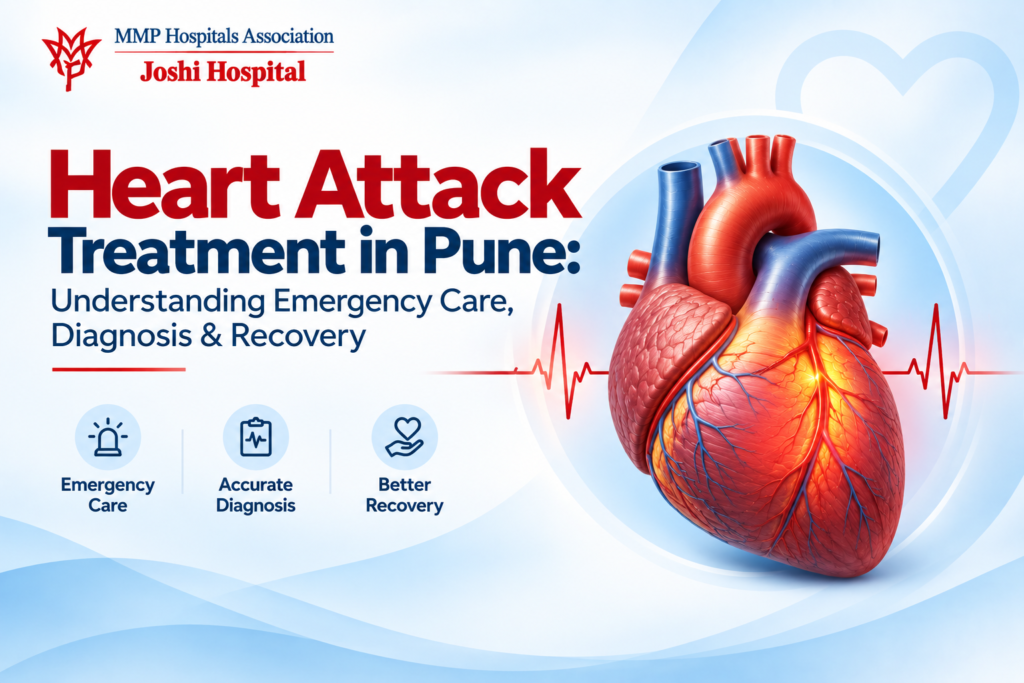
A heart attack is a medical emergency in which blood flow to a part of the heart muscle becomes severely reduced or blocked. When this happens, the affected heart muscle does not receive enough oxygen and can begin to suffer damage.
For patients and families searching for Heart Attack Treatment in Pune, understanding what happens during the first few minutes and hours can help them recognize why timely medical care matters.
At Joshi Hospital, Pune, cardiac care includes evaluation of acute chest pain and suspected heart attacks, diagnostic assessment, emergency management and ongoing cardiovascular care.
What Happens During a Heart Attack?
A heart attack is medically known as a myocardial infarction (MI).
Most heart attacks are related to coronary artery disease. Over time, fatty deposits known as plaque can accumulate within the coronary arteries that supply blood to the heart muscle.
If a plaque becomes disrupted or ruptures, a blood clot may develop. The clot can suddenly reduce or completely stop blood flow through the affected artery.
Without adequate oxygen-rich blood, the heart muscle can become damaged.
This is why suspected heart attack symptoms should not be watched at home while waiting to see whether they improve.
What Are the Warning Signs of a Heart Attack?
Heart attacks do not always look the same.
Some people experience sudden, intense chest pain. Others develop relatively mild or less typical symptoms.
Possible warning signs include:
- Pressure, heaviness, squeezing or discomfort in the chest
- Pain or discomfort spreading to the arm, shoulder, jaw, neck or back
- Shortness of breath
- Cold sweating
- Nausea or vomiting
- Dizziness or light-headedness
- Unusual weakness or fatigue
- Rapid or irregular heartbeat
Women, older adults and people with diabetes may sometimes experience less typical symptoms, although anyone can have an atypical presentation.
If you suspect a heart attack, seek emergency medical assistance immediately rather than attempting to diagnose the symptoms yourself.
How Is a Heart Attack Diagnosed?
When a patient reaches the emergency department with symptoms suggestive of a heart attack, the priority is rapid clinical assessment.
Doctors may use several investigations depending on the patient’s condition.
1. ECG
An electrocardiogram (ECG) records the electrical activity of the heart.
It is an important early investigation in suspected acute coronary syndrome and can help doctors identify changes that may indicate a heart attack or other cardiac problem.
2. Cardiac Troponin Blood Test
Troponin is a protein released into the bloodstream when heart muscle is injured.
Measuring cardiac troponin can help doctors determine whether heart-muscle injury has occurred. Depending on the clinical situation, repeat measurements may be required.
3. Echocardiography
An echocardiogram uses ultrasound to evaluate the heart’s structure and function.
It can help assess:
- Heart pumping function
- Movement of different areas of the heart muscle
- Heart valves
- Certain complications associated with a heart attack
4. Coronary Angiography
Coronary angiography allows cardiologists to visualize the arteries supplying blood to the heart.
If a significant blockage is identified, angiography can help doctors decide whether blood flow should be restored using angioplasty and stenting or whether another revascularization strategy is appropriate.
STEMI vs NSTEMI: Why the Type of Heart Attack Matters
Heart attacks are not all identical.
Two important clinical categories are:
STEMI
A ST-elevation myocardial infarction (STEMI) is generally associated with an acute coronary artery occlusion and characteristic ECG findings.
Restoring blood flow rapidly is a major priority.
NSTEMI
A non-ST-elevation myocardial infarction (NSTEMI) also involves heart-muscle injury but may have a different pattern on the ECG and coronary angiography.
The timing and type of invasive treatment depend on the patient’s clinical risk, symptoms, investigations and overall condition.
Both conditions require medical evaluation and appropriate treatment.
How Is a Heart Attack Treated?
Treatment is individualized according to the type of heart attack, severity of symptoms, coronary anatomy, bleeding risk, other medical conditions and the patient’s overall clinical status.
Medicines Used During Heart Attack Care
Depending on the individual patient, doctors may use medicines such as:
- Antiplatelet medicines
- Anticoagulants
- Cholesterol-lowering therapy
- Medicines to relieve ischemic symptoms when appropriate
- Other cardiovascular medicines according to clinical need
These medications are not suitable for every person in exactly the same way.
Patients should not self-medicate or change prescribed heart medicines without medical advice.
Angioplasty and Stent Placement
Percutaneous coronary intervention (PCI) is commonly used to restore blood flow through a significantly narrowed or blocked coronary artery.
During PCI, a catheter is guided through a blood vessel to the affected coronary artery.
A small balloon may be inflated to open the narrowed area, and a coronary stent is commonly placed to help keep the artery open.
For appropriate patients with an acute heart attack, timely PCI can restore coronary blood flow and limit ongoing heart-muscle injury.
When Might Bypass Surgery Be Considered?
Not every coronary blockage is best treated with a stent.
Coronary artery bypass grafting (CABG) may be considered in selected patients depending on factors such as:
- Number of coronary arteries affected
- Location of the disease
- Complexity of the coronary blockages
- Diabetes
- Heart function
- Other medical conditions
- Suitability for PCI
- Surgical risk
The decision between PCI and CABG should therefore be based on the individual patient’s clinical circumstances and coronary anatomy.
Why Time Matters During a Heart Attack
During a heart attack, prolonged interruption of blood supply can lead to greater heart-muscle damage.
That is why recognizing symptoms and seeking emergency medical care promptly is important.
A common mistake is assuming chest discomfort is due to gas, acidity, muscular pain or stress and waiting several hours before seeking medical attention.
Symptoms alone cannot reliably determine their cause.
When chest discomfort is new, severe, persistent or associated with sweating, breathlessness, nausea, faintness or pain spreading to the arm or jaw, urgent assessment is appropriate.
What Happens After Heart Attack Treatment?
Treatment does not end after blood flow has been restored.
A heart attack indicates underlying cardiovascular disease that requires continued management.
After stabilization, the treating team may evaluate:
- Heart pumping function
- Cholesterol levels
- Blood pressure
- Blood glucose or diabetes
- Kidney function
- Smoking or tobacco exposure
- Body weight
- Physical activity
- Diet
- Other cardiovascular risk factors
This information helps guide long-term treatment and reduce the risk of future cardiovascular events.
Medicines After a Heart Attack
Depending on the individual case, long-term therapy may include antiplatelet medication, lipid-lowering treatment and other medicines for cardiovascular protection.
For patients with acute coronary syndrome who are not at high bleeding risk, current guidelines generally recommend dual antiplatelet therapy for a defined period, although the exact regimen and duration must be individualized.
Patients should take their medicines exactly as prescribed and discuss any side effects or concerns with their treating doctor.
Never stop prescribed antiplatelet medication after coronary stenting without medical advice.
Cardiac Rehabilitation and Recovery
Recovery after a heart attack involves more than allowing the heart to heal.
Cardiac rehabilitation can form an important part of recovery for eligible patients.
A rehabilitation program may include:
- Medically appropriate physical activity
- Education about heart disease
- Cardiovascular risk-factor management
- Nutritional guidance
- Support for returning to normal activities
- Smoking cessation support when required
The pace of recovery differs from one person to another. Patients should follow individualized advice regarding exercise, work, driving and other physical activities.
Can Another Heart Attack Be Prevented?
No strategy can guarantee that another heart attack will never occur, but controlling modifiable cardiovascular risk factors can reduce future risk.
Important measures may include:
Control blood pressure:
High blood pressure increases cardiovascular strain and should be appropriately managed.
Manage cholesterol:
Lipid-lowering treatment can be an important component of secondary prevention after a heart attack.
Manage diabetes:
Good diabetes management is particularly important for cardiovascular health.
Avoid smoking and tobacco:
Tobacco use is a major modifiable cardiovascular risk factor.
Follow a heart-healthy eating pattern:
A balanced diet emphasizing vegetables, fruits, whole grains and other appropriate foods can support cardiovascular health.
Stay physically active as medically advised:
Exercise recommendations after a heart attack should be individualized.
Take prescribed medication consistently:
Do not discontinue heart medicines because symptoms have improved.
Attend follow-up appointments:
Regular follow-up allows doctors to monitor recovery and modify treatment when necessary.
When Should You Go to the Emergency Department?
Seek immediate emergency medical care for new or severe symptoms such as:
- Chest pressure, squeezing or heaviness
- Chest discomfort lasting more than a few minutes or repeatedly returning
- Severe breathlessness
- Cold sweating with chest discomfort
- Fainting or near-fainting
- Chest discomfort with nausea or vomiting
- Pain spreading to the arm, shoulder, jaw, neck or back
- Sudden significant deterioration in a person with known heart disease
Do not wait for a routine cardiology appointment when symptoms suggest a possible heart attack.
Heart Attack Care at Joshi Hospital, Pune
Joshi Hospital, Pune provides cardiology services for patients with heart-related conditions, including assessment of acute chest pain and suspected cardiac emergencies.
The hospital’s cardiology services include ECG, 2D echocardiography, cardiac biomarkers and other cardiac diagnostic and management services according to the patient’s clinical requirements.
For patients presenting with suspected heart attack symptoms, timely assessment helps the medical team determine whether the symptoms represent acute coronary syndrome and what treatment strategy is appropriate.
For someone researching Heart Attack Treatment in Pune, it is important to choose care based on clinical needs, available emergency services and advice from qualified healthcare professionals rather than delaying treatment to compare hospitals during an emergency.
The Key Message: Don’t Ignore Possible Heart Attack Symptoms
A heart attack can occur suddenly, but symptoms are not always dramatic.
Chest discomfort, breathlessness, sweating, nausea, unusual weakness or pain spreading to the arm or jaw should be taken seriously, particularly in people with cardiovascular risk factors.
Early recognition, rapid medical assessment, appropriate restoration of coronary blood flow when required, and long-term cardiovascular risk management are all important parts of heart attack care.
If you think you or someone around you may be experiencing a heart attack, seek emergency medical assistance immediately.
Medical Disclaimer
This article is intended for general educational purposes only. It should not be used to diagnose a heart attack or determine an individual’s treatment. Heart attack treatment depends on the patient’s symptoms, ECG, blood tests, coronary anatomy and overall clinical condition. Seek immediate medical care for suspected heart attack symptoms.